
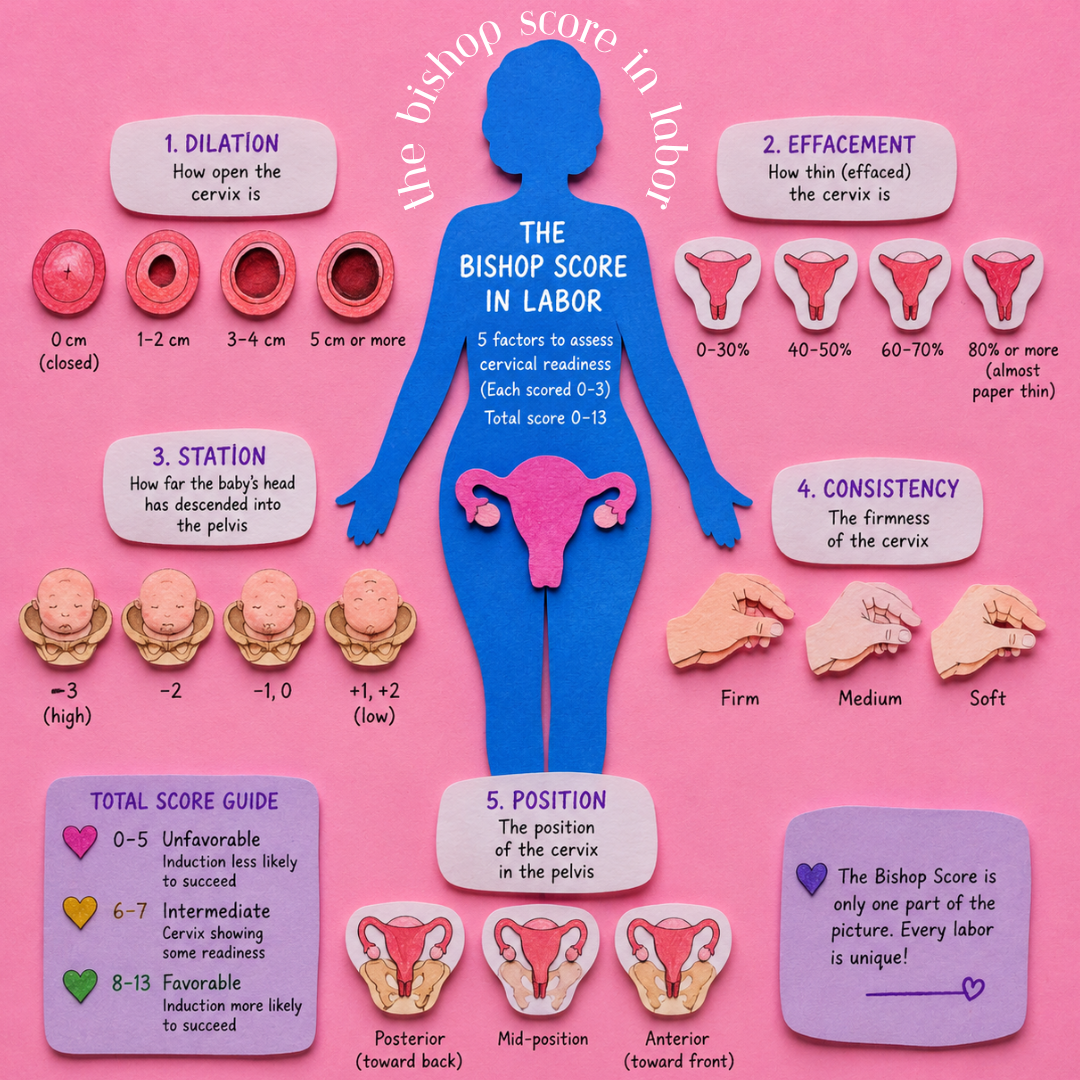
As labor approaches or begins, healthcare providers may perform a cervical exam and mention the Bishop Score. This scoring system helps evaluate how ready a woman’s body is for labor and can guide decisions about induction, cervical ripening, and expectations for the birth process.
What Is the Bishop Score?
The Bishop Score is a clinical assessment used to evaluate the condition of the cervix and the baby’s position in the pelvis. It combines five findings from a cervical examination into a single score that helps estimate how favorable the cervix is for labor and vaginal delivery.
Although it is most commonly used before or during labor induction, it can also provide helpful information about labor progression and cervical readiness.
The Five Components of the Bishop Score
Cervical Dilation
Dilation measures how open the cervix is, from completely closed to fully dilated at 10 centimeters.
As labor progresses, the cervix gradually opens to allow the baby to pass through the birth canal. Greater dilation contributes to a higher Bishop Score.
Cervical Effacement
Effacement refers to the thinning and shortening of the cervix.
Before labor, the cervix is typically long and thick. During labor, it becomes progressively thinner until it is nearly paper-thin, making it easier for the baby to descend.
Fetal Station
Station describes where the baby’s presenting part—most often the head—is located in relation to the mother’s pelvis.
A baby that has descended lower into the pelvis receives a higher score because engagement often indicates that labor is progressing.
Cervical Consistency
The cervix changes from being firm during much of pregnancy to becoming softer as labor approaches.
A soft cervix is generally more responsive to contractions and easier to dilate.
Cervical Position
During pregnancy, the cervix often points toward the back of the body. As labor nears, it typically moves toward the center and then to a more forward (anterior) position.
An anterior cervix is considered more favorable for labor.
Interpreting the Score
The total Bishop Score generally ranges from 0 to 13.
- 0–5: The cervix is considered relatively unfavorable for labor or induction.
- 6–7: The cervix shows moderate readiness and may continue changing with time or contractions.
- 8 or higher: The cervix is generally considered favorable, suggesting that labor or induction is more likely to progress successfully.
A high score does not guarantee a fast labor, and a low score does not prevent a woman from going into spontaneous labor shortly afterward.
How the Bishop Score Is Used During Labor
During labor, the Bishop Score can help healthcare providers:
- Assess whether the cervix is responding to contractions.
- Determine if labor induction methods are likely to be effective.
- Decide whether cervical ripening techniques may be beneficial before induction.
- Monitor overall progress when combined with contraction patterns, maternal symptoms, and fetal well-being.
However, once a woman is in active labor and making steady cervical change, providers often focus more on ongoing cervical examinations and clinical progress than on the Bishop Score itself.
Why It Is Only One Part of the Picture
The Bishop Score does not measure contraction strength, how a mother is coping with labor, fetal heart rate patterns, or the baby’s position within the pelvis beyond station. Healthcare providers also consider many other factors, including:
- The frequency and effectiveness of contractions.
- The health of the mother and baby.
- Whether the membranes have ruptured.
- The reason for induction, if one is planned.
- Previous birth history and any medical conditions.
For Expectant Mothers
If your healthcare provider mentions your Bishop Score, remember that it is simply a tool to help guide clinical decision-making. Labor is dynamic, and the cervix can change significantly over a short period of time. Many women with low initial scores go on to have successful vaginal births, while others with high scores may still experience longer labors.
Understanding the Bishop Score can help mothers participate in informed conversations about labor progression, induction, and birth planning while recognizing that every labor unfolds differently.


