
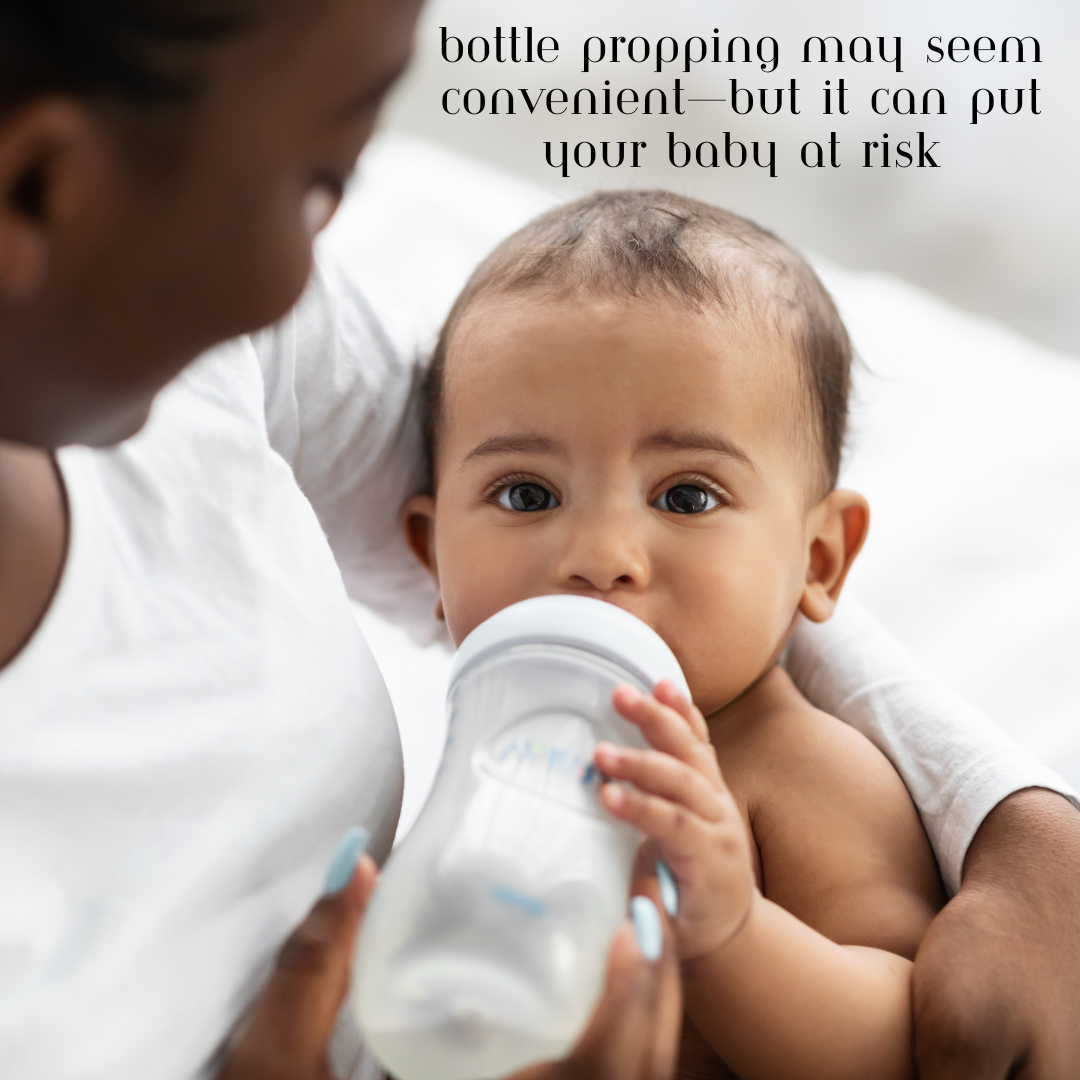
Caring for a newborn can be exhausting. When your baby needs to eat frequently, especially during the middle of the night or while you are trying to handle other responsibilities, it may be tempting to prop a bottle against a blanket, pillow, stuffed animal, or other object so your baby can drink without someone holding the bottle.
However, bottle propping is not considered a safe feeding practice.
A baby should not be left to drink from a bottle that has been propped into their mouth. Beyond the immediate concern of choking, routinely allowing milk or formula to remain in a baby’s mouth can contribute to problems involving the ears, teeth, mouth, and feeding experience.
Bottle propping can become especially concerning when a baby is lying down, falling asleep, or surrounded by blankets, pillows, or other objects used to hold the bottle in place. Safe-sleep practices are important for reducing the risk of sleep-related infant deaths, including Sudden Infant Death Syndrome (SIDS).
What Is Bottle Propping?
Bottle propping means positioning a bottle so that the nipple remains in the baby’s mouth without a caregiver actively holding and controlling the bottle.
For example, a caregiver may place the baby down and use a blanket, pillow, stuffed animal, or another object to hold the bottle in place.
The problem is simple:
The milk can continue flowing even when your baby needs it to stop.
Young babies are still developing the ability to coordinate sucking, swallowing, and breathing. When you hold the bottle yourself, you can watch your baby’s cues and remove or lower the bottle when your baby needs a break.
A propped bottle cannot respond to those cues.
1. Bottle Propping Can Increase the Risk of Choking
One of the most serious concerns is choking.
A baby may cough, gag, become overwhelmed by the flow of milk, fall asleep, or simply stop wanting to drink. If someone is holding the bottle, they can immediately remove it.
When the bottle is propped, however, the nipple may remain in the baby’s mouth.
Babies should be actively supervised during bottle feeding. Never assume that because your baby has successfully taken a bottle many times before, they can safely be left alone with one.
Feeding time is not the time to walk away.
2. Bottle Propping and Safe Sleep: What About SIDS?
Bottle propping should also be discussed as part of the larger conversation about safe infant sleep.
SIDS, or Sudden Infant Death Syndrome, refers to the sudden, unexplained death of a baby younger than one year that remains unexplained even after a thorough investigation.
It is important to understand that bottle propping itself should not be described as a direct cause of SIDS. However, some of the circumstances that can accompany bottle propping can create an unsafe sleep environment.
For example, parents should never use:
- Pillows
- Loose blankets
- Stuffed animals
- Positioning devices
- Other soft objects
to hold a bottle in a baby’s mouth—especially if the baby is becoming sleepy.
If your baby falls asleep during or after a feeding, the bottle should be removed and the baby should be placed in a safe sleep space.
For sleep, babies should generally be placed on their backs on a firm, flat sleep surface in a safety-approved crib, bassinet, or portable play yard with no loose blankets, pillows, stuffed animals, or other soft objects around them.
A sleeping baby’s crib should not contain a propped bottle.
Feeding and safe sleep should remain two separate activities: actively supervise the feeding, and when feeding is finished, transition your baby to a safe sleep environment.
3. Bottle Propping May Contribute to Ear Infections
Bottle feeding while a baby is lying flat can increase concern about fluid reaching the area around the Eustachian tubes, which connect the middle ear to the back of the throat.
Babies’ Eustachian tubes are shorter and more horizontal than those of adults. Feeding practices that allow milk to pool toward the back of the mouth—particularly feeding while lying flat—may contribute to conditions that make middle-ear problems more likely.
This is one reason it is better to hold your baby in a more upright or semi-upright position during bottle feeding rather than leaving the baby flat with a propped bottle.
If your baby experiences repeated ear infections, discuss feeding position and other possible risk factors with your pediatrician.
4. Milk Sitting Around the Teeth Can Cause Tooth Decay
Once your baby’s teeth begin coming in, prolonged exposure to milk, formula, juice, or other carbohydrate-containing drinks can contribute to tooth decay.
Milk contains naturally occurring sugars, and infant formula also contains carbohydrates. When a baby continuously sucks on a bottle or falls asleep with milk remaining around the teeth and gums, bacteria in the mouth can use those carbohydrates to produce acids that attack tooth enamel.
This can contribute to early childhood tooth decay.
Baby teeth matter.
They help children chew, learn to speak, maintain space for permanent teeth, and develop healthy eating patterns.
Do not routinely put your baby to sleep with a bottle of milk or formula.
5. Bottle Propping Can Make It Easier to Miss Fullness Cues
Babies communicate during feeding long before they can speak.
A baby who has had enough may:
- Turn their head away.
- Stop sucking.
- Slow their sucking.
- Push the nipple away.
- Close their mouth.
- Become relaxed or distracted.
- Lose interest in eating.
When you are holding and watching your baby, you can recognize these signals and stop the feeding.
A propped bottle makes the feeding more automatic. The bottle may remain available even after your baby has started communicating:
“I’m done.”
Bottle-fed babies should not automatically be expected to finish every ounce in a bottle.
6. Feeding Is Also an Opportunity for Connection
Bottle feeding is not simply about transferring milk from a bottle into a baby’s stomach.
It is also an opportunity to hold your baby, make eye contact, speak softly, notice changes in behavior, and learn your baby’s hunger and fullness cues.
This applies whether the bottle contains formula, pumped breast milk, or a combination of the two.
Responsive feeding means paying attention to your baby and responding to what they are communicating.
Safer Bottle-Feeding Practices
When giving your baby a bottle:
Hold your baby during the feeding. Keep your baby supported rather than leaving them alone with a bottle.
Keep your baby relatively upright. Avoid routinely feeding your baby while they are lying completely flat.
Hold the bottle yourself. Do not use blankets, pillows, stuffed animals, or bottle-holding devices to keep the nipple in your baby’s mouth.
Watch your baby’s face and breathing. Pause if your baby coughs, gulps rapidly, milk spills from their mouth, turns away, or appears overwhelmed.
Allow breaks. Babies do not necessarily need a continuous stream of milk.
Follow your baby’s fullness cues. Do not force your baby to finish a bottle simply because milk remains.
Remove the bottle when your baby falls asleep.
Never leave your baby unattended during a bottle feeding.
Keep the sleep space empty. Do not leave bottles, pillows, blankets, stuffed animals, or bottle-propping objects in your baby’s sleep space.
“But My Baby Holds Their Own Bottle”
Eventually, some babies develop the motor skills to grab and hold their bottles.
That does not mean an infant should be left unsupervised while eating.
Being physically capable of holding a bottle is different from being developmentally capable of safely managing every problem that could occur during a feeding.
Continue supervising bottle feedings even as your baby becomes increasingly independent.
What If You’ve Already Been Propping the Bottle?
If you have done this before, the important thing is to change the practice going forward.
Many parents are never specifically taught about bottle propping. Something that looks convenient or harmless may not seem risky until someone explains what can happen.
You can begin safer feeding habits with the very next bottle.
If your baby frequently coughs or chokes during feedings, has difficulty coordinating sucking and swallowing, repeatedly develops ear infections, has feeding difficulties, or you have concerns about your baby’s teeth or mouth, speak with your baby’s pediatrician or pediatric dentist.
The Bottom Line
A bottle should not replace the person feeding the baby.
Bottle propping may seem like a convenient way to free your hands, but it removes your ability to control the bottle and immediately respond to your baby’s feeding cues.
The concerns include choking, unsafe milk flow, ear problems associated with feeding while lying flat, tooth decay from prolonged exposure to milk or formula, missed fullness cues, and unsafe sleep conditions when bottles or propping materials are left with a sleeping baby.
Bottle propping should not be described as a direct cause of SIDS. However, safe feeding and safe sleep go together. Once your baby is finished eating or begins falling asleep, remove the bottle and place your baby in an appropriate safe sleep environment.
Hold the baby. Hold the bottle. Watch the baby eat. Then put baby down safely to sleep.
Those few minutes of active supervision are worth it.
This article provides general educational information for doula clients and is not a substitute for individualized medical or dental advice from your baby’s pediatrician, pediatric dentist, or other qualified healthcare professional.


